kesherian skies info
Kesherian skies is a worldbuilding project containing Kesheri. Orbital parameters are written as [semi major axis, eccentricity, inclination, argument of pariapsis, longitude of ascending node, mean anomoly], with angles in degrees relative to Kesheri at kesherian year 0, length in lightyears for stars, AU for planets, and light-seconds for moons, unless specified otherwise. Spin is written as a vector pointing in the rotational axis (at year 0), with magnitude specifying rotation period in days (+x is in kesheri's position at year 0, +y is 90° orbitwise from that, and +z is x cross y).
Kesol
orbit = [30923,0.01,89 [kesheri relative]/2 [disk relative],82,129,93], spin = [0.9,-4,30], mass = 1 solar, radius = 1 solar
The center of the Kesol system, orbiting around BH1 (according to the kesherian astronomical catalouge), aka Aja's Singularity (which is 7.22882 million solar masses). Kesol is a G2V-type star and is 3.48 billion years old, and has low activity. Its magnetic field is very big, with the front of its heliopause being at 125 AU from it. It has a metalicity (mass fraction of elements that aren't hydrogen or helium, and yes that includes oxygen) of around 1%.
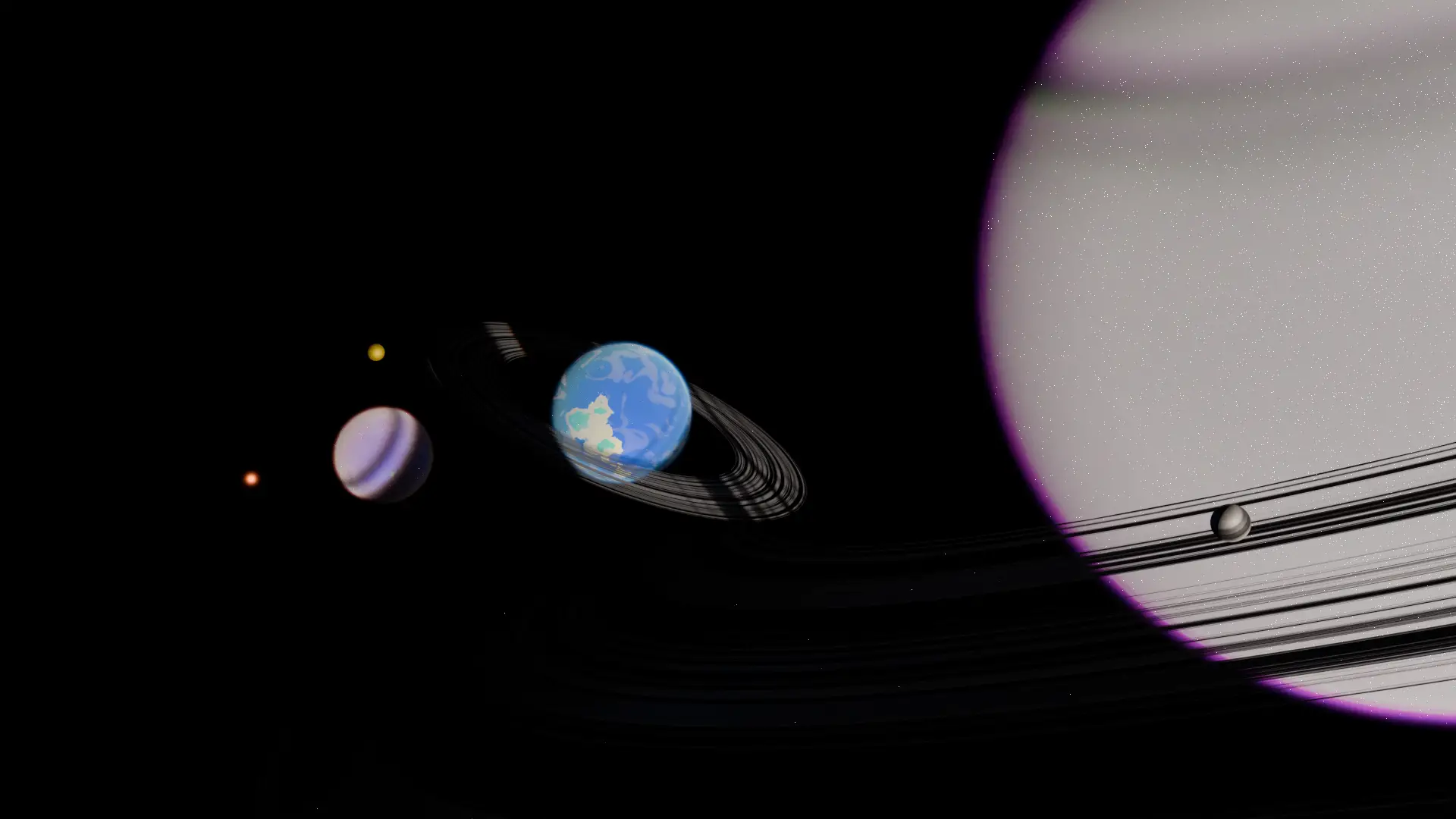
An image of the kesol system (without Kesol except for lighting). From left to right: Antasheria, Accuria, Marda, Kesheri, Melat, and Juna.
Antasheria
orbit = [0.1,0.1,10,59,296,55], spin = [0.9,-4,3], mass = 0.2 earth, radius = 0.1 earth
Antasheria is the first planet in the Kesol system. It is molten, due to tidal heating, magnetic heating, and being close to Kesol, along with the liquid parts constantly spreading heat all around it. It actually glows a bit on the night side. This planet thus has no atmosphere.
Kesheri
orbit = [1,0.01,1,0,0,0], spin = [0,0.6,1.2], mass = 1 earth, radius = 1 earth
Kesheri is the main planet in Kesherian skies, as the name indicates. It is very earthlike, except for its rings from a massive amount of very fast dust in its orbit. These dust particles sometimes get captured by Kesheri, adding to its ring system, until its exosphere slows them down, and they fall (something known as ringfall). This created a lot of evolutionary pressure, and thus promoted cooperation more. Kesheri's rings are very extensive, and the constant "wind" of extra dust helps keep it apart. The rings themselves are just ice and rock. Kesheri's magnetosphere strength is around that of Earth's, but a lot less disorganized. Of most note, however, is the Kats, a very advanced intelligent species.
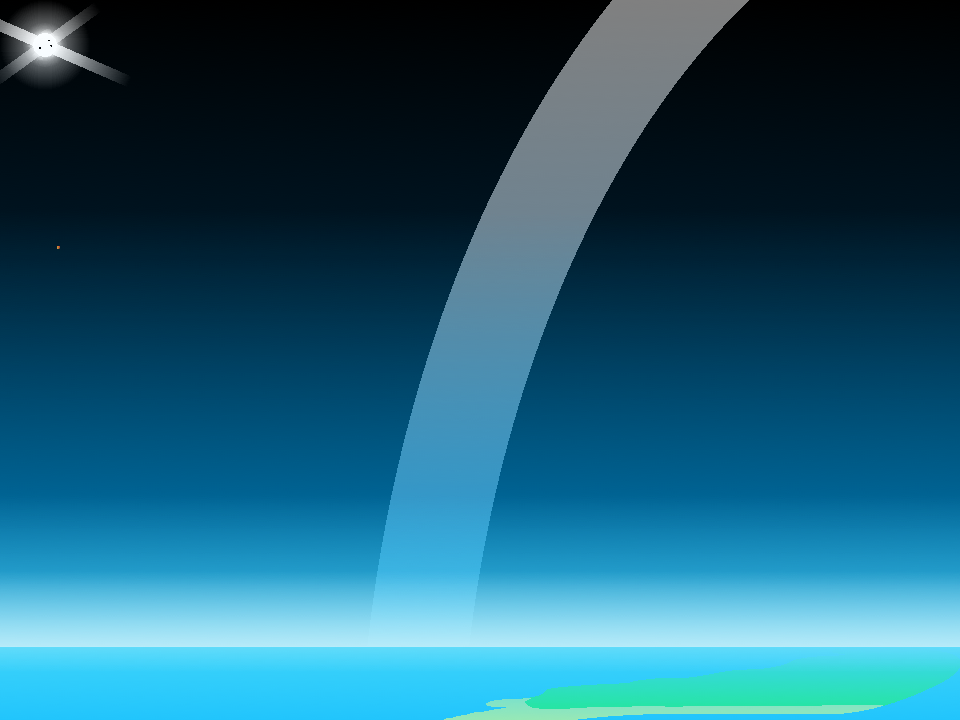
This one is a png from an SVG, showing a view at the start of Kesheri's thermosphere. The orange dot is Antasheria, and the white thing is Kesol.
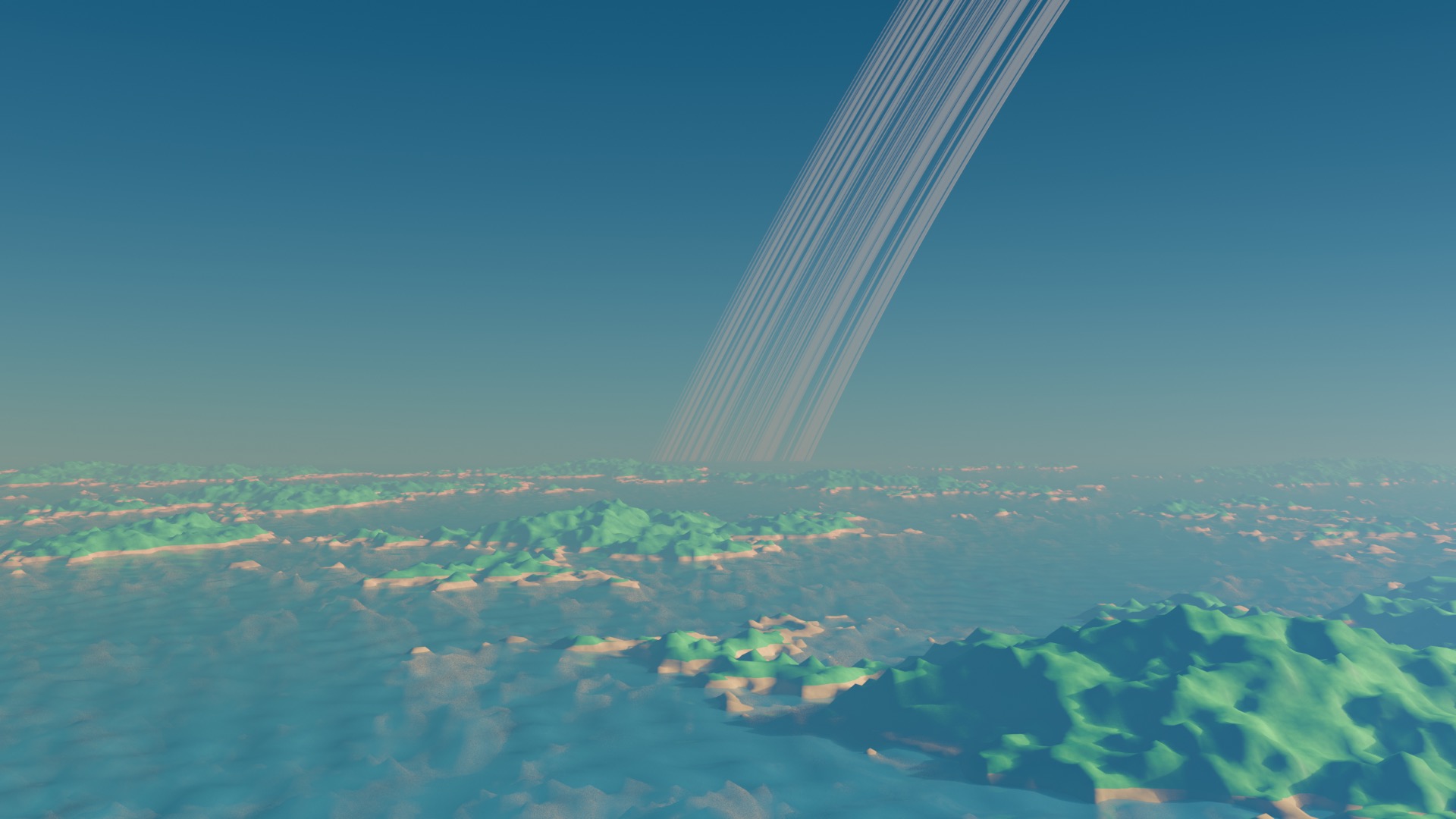
This is a blender render of Kesheri's surface. Yes, the ring texture is canon.
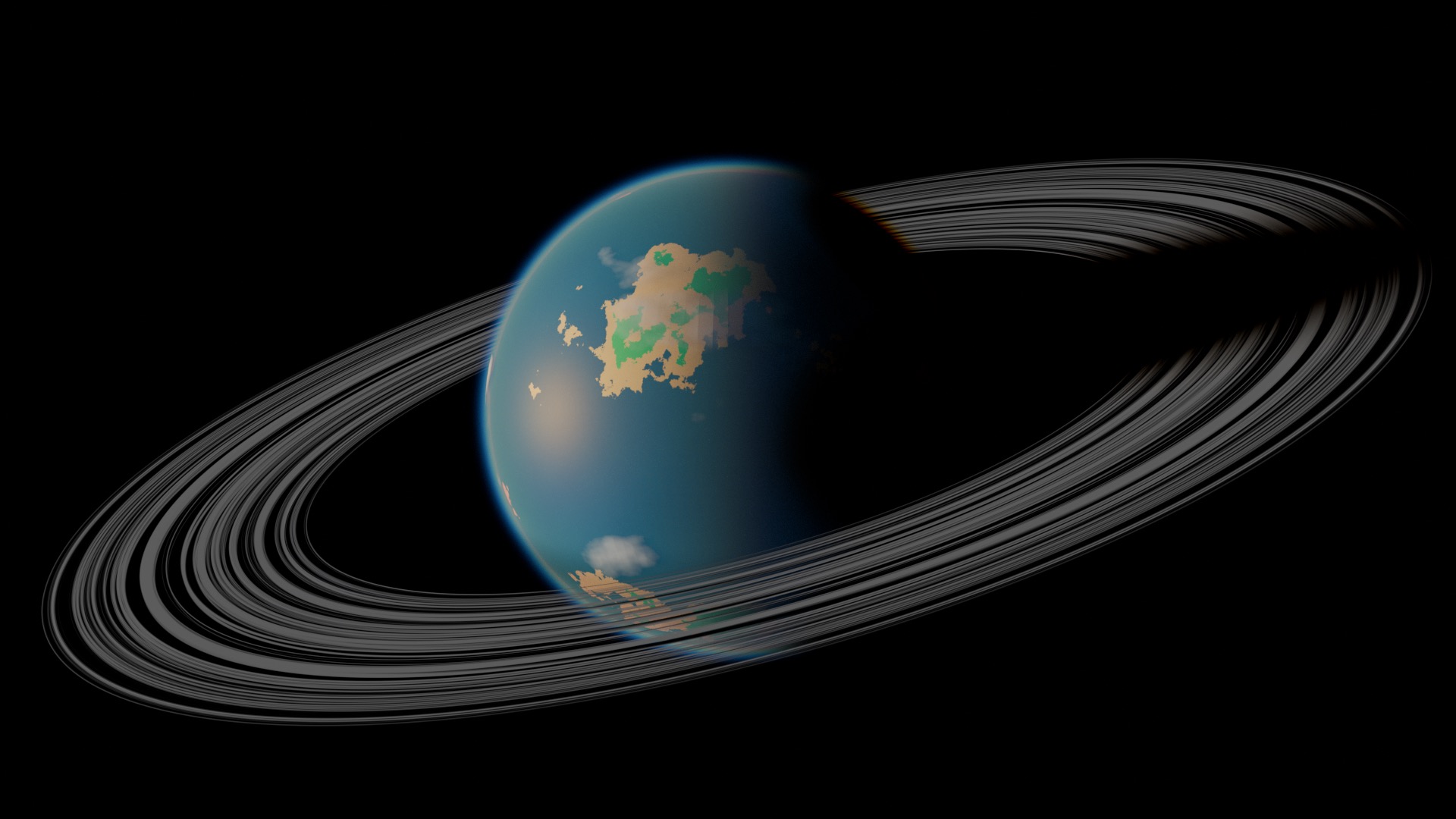
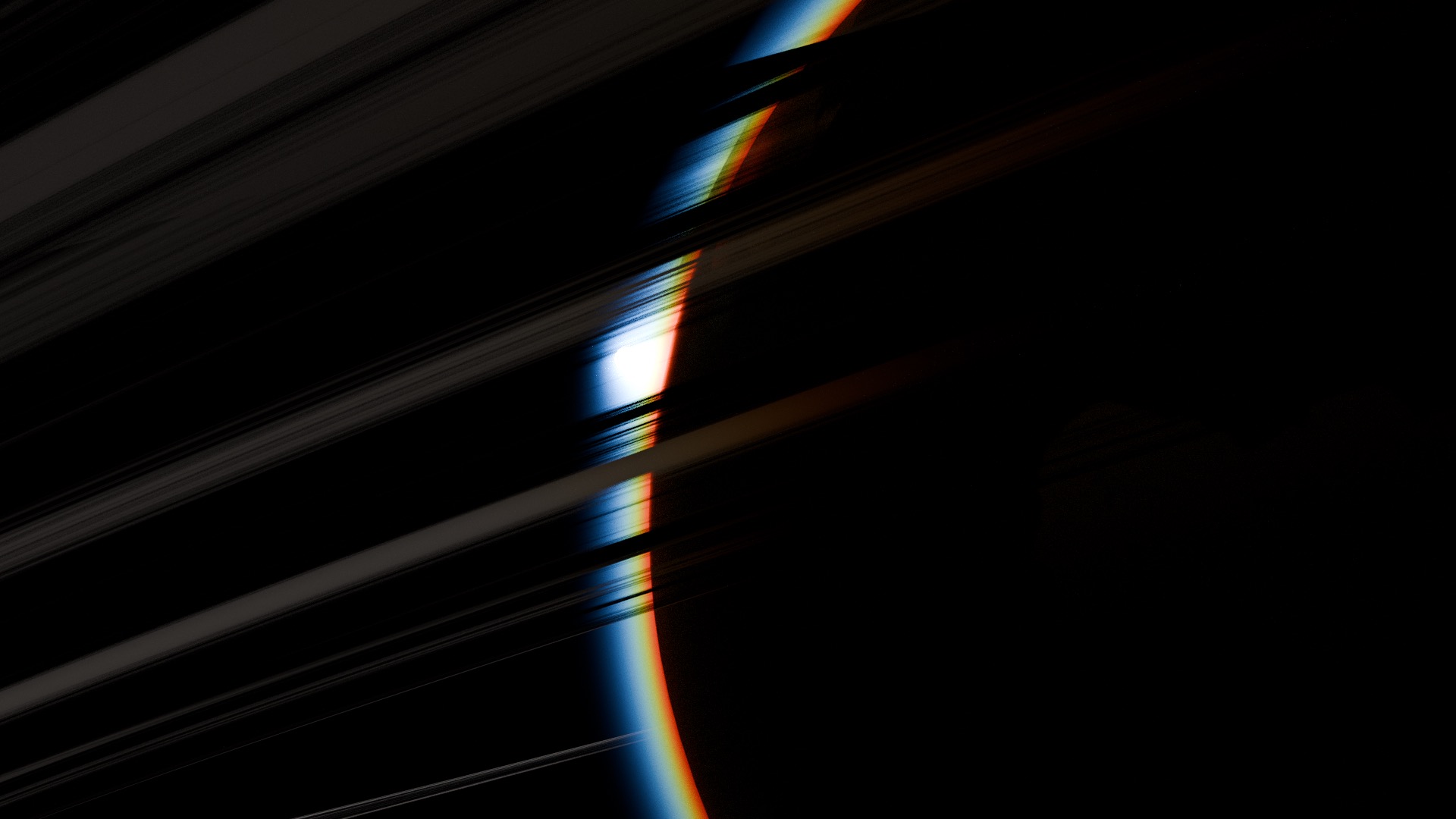
These images are Kesheri from space. The first is just Kesheri, and the second one shows Kesol sunsetting from space.
Marda
orbit = [1.9,0.02,-1,92,282,172], spin = [0,0.2,0.8], mass = 0.2 earth, radius = 0.6 earth
Marda has a thick red atmosphere, but a lot of copper sulfate, It it not good to be on it. It also has a moon. The pressure is high enough to cause a CO₂ cycle, and there's some liquid CO₂ lakes. Don't step in them.
Accuria
orbit = [0.2,0.02,-3 [marda relative],1,-2,82], spin = [tidally locked], mass = 0.05 luna, radius = 0.4 luna
Accuria is a sulfery moon. It also has a bit of SO₂ in an exosphere. It's a bit good for sulferic acid production, but useless otherwise.
Juna
orbit = [3.8,0.02,2,276,47,72], spin = [0.03,-0.02,0.1], mass = 1.2 jup, radius = 0.94 jup
Juna is a purple-ish gas giant. It is very, very massive. It has a static charge that gives it a 7.17 T magnetic field via its rotation (due to triboelectricity with moons). By mole fraction, it is 70% hydrogen, 20% helium, 5% radon, 3% nitrogen, 0.9% oxygen, 0.1% carbon monoxide, and the rest of the 1% is SiO₂ junk from its range. It canonically has 4 moons, but only 1 has been finished.
Melat
orbit = [0.8,0.05,1 [juna relative],1,-1,329], spin = [tidally locked], mass = 0.7 luna, radius = 0.7 luna
Melat is mostly iron and nickel (probably captured from the inner system), and it's made of a lot of conductive stuff. Its resistivity around 5 nΩ/m at its surface. This gives it a constant voltage, although due to craters and other things, an electret-magnet compass is still useless. Useful for its metals.
Kats
Kats are the species that lives on Kesheri. They currently are experimenting with tachyon dynamics and interuniversal travel.
Identification
Kats are identified by their common name (kat) and scientific name (felius kesheri). To avoid confusion when discussing species from many planets, region is used. For kesherian life, this is kesheri, and for earth life, this is terra. This only changed between planets, and is based on planet of ancestor (species-mixing between planets has not been observed, so this works).
Kinetics
Kats are a lot like cats in terms of their ears, tail, paws, and fur. They are still pretty different. They can walk quadrapedaly and bipedaly, and also have cartalige "bones", meaning they can both be digitigrade and plantigrade. This does pose a challenge for medical care, as kats can also hear ultrasonic frequencies, and x-rays pass through cartilage. Anyways, kat paws are also more dexterous, with slightly smaller pads and independent toe control. Their tail can also grip things. Their bite force is around 50 newtons, and the resulting pressure is usually around 8.9 MPa (megapascals), or around 87 atmospheres. This isn't actually that useful, since it only really exists on their teeth. Their whole body weight is around 7-13 lbs as an adult, and they grow to around 1ft tall. Usually, you'll see them walking quadrapedally, but they walk bipedally in places that need to be cleaner or more percisley handeled.
Biochemistry
Kats are mostly carbon-based, however they have some sillicon mixed in. This sillicon is most likley from Kesobacter Sillica, which is a bacteria in Kesheri's mantle, but can get to the surface by volcanic eruption. It is theorized that sillicon-based parts from these got into an area with pre-kats (felius protosheri), which mostly got rejected, but a small amount is interfaced with neurons for sillicon-based computing, making kats really good at fast math. They are still mostly biological. Kats also have a protien called bifurcane, which acts as a triplexjunction, and perserves the strength of covalent bonds. However, it is not used much, as knots can be made in protiens if needed.
Senses
Kats don't have a good sense of smell. Instead, they rely on a pattern inside their eyes, which is a hexagonal array that diffracts light. They can see color from 400 to 600 nm like humans, but with 5 cones in that range, and their rods go from 350 to 720 nm. Kats can hear from 40 Hz to 50 KHz.
Habitats
Kats (on their own) can live in places with plantlife between 40° F to 90° F, and perfer around 75° F. They can swim, but don't usually do it. When they do, they can survide a pH from around 5.6 to 7.9, and a salt concentration from 0.2% to 0.5%.
Technology
Kat technology was a fair bit different from ours, since where they first started (a plains biome) didn't have much "trees" at all, and the ones nearby weren't that strong. Instead, they had to figure out how to knap stones. They actually still have this knowledge, despite how useless it is when you have a steel 3d printer in your house. They discovered many allows, mainly with copper and tin. Since they also happened to be near the equator, this alloy was very useful to protect against occasional pelting with 20 km/s rocks. Casting was quite easy, since they has a lot of kaolin clay near the ocean (which is where they settled near). Fire was useful for heating, like usual, but the nearby sand helped for way more glass production, although glassblowing was a lot harder for kats (since they have fur), and so instead they casted it, like with copper. Once someone figured out that more air could sometimes make fire stronger, they were able to melt iron with more common materials. By oxidizing this with a good amount of charred sticks, steel was made, and used for a lot of things, like improving already-existing mechanical power systems. Copper and zinc were used to make the first batteries (galvanic cells), then spinning metal plates with magnetite (homopolar generators), which were eventually used to make electricity. This was further improved upon until, in kesherian year 2082, a superconductor that could survive 60° C was found, used to make quantum processing units for more processing. In the meantime, space travel was invented and improved upon a lot, leading to the discovery of other star systems, and eventually their universe's edge (which they happened to be near). As of now (kesherian year 4827), tachyonic beams have been discovered (and are being used) to break the edge of the universe, which (with active stabalization until spacetime was stable again) let them see the rest of their multiverse.
Ovbiously, this is just a fraction of what kats have invented. Putting all kesherian inventions on here would probably destroy your device.
Archversal physics
There are many universes aside from Kesheri's. Universes are denoted as U-[id], for example Kesherian Skies (the one kesheri is in) is U-000. Multiverses are M-[id], multiverses of multiverses (metaverses) Me-[id], gigaverses G-[id], etc. It is more common to use A[level]-id for things higher than gigaverses (like A0-000 for Kesherian Skies, or A1-000 for kesheri's multiverse, or A3-923 for the SCP metaverse).
These are all archverses, and there is probably an infinite amount of them in total, although only a finite amount in Kesheri's everything. They are all contained in cetiverses, which are denoted as C-[id]. As archverses get bigger, spacetime becomes more unstable. Cetiverses, being very big, are thus very unstable, usually with a constant plasma.
Stabalizing spacetime is already required for inter-multiversal travel, as multiverses have different physics from each other, but in cetiverses, the stabalizer usually requires terawatts to stay active. Cetiverses are contained in rectangular prisms called everythings. These are very bright white from the inside, but are seperated by The Void. The Void is a place with no physics or concept of spacetime or anything except everythings (denoted E-[id]). Going between everythings requires spacetime to be ruptured into The Void and the tube must be kept open.
The Void is in a reality computer, R-0-0. R[i]-[j] is a level [i] reality computer, and [j] indicates which one, 0 for the one with Kesheri in it (or in a computer within it, or etc), and higher by radar distance from R[i]-0. A level i reality computer is contained in a level i+1 reality computer. The level and id are both ordinals, which can be negated if needed (for reality computers in R0-0, for example). Real life is canonically RΩ-0, but it can never be accessed, since Ω is an uncountable ordinal.
Archverses within R0-0 are the main thing for archversal physics near Kesherian Skies, however, since different levels are usually isolated, only accesible by I/O systems in computers. Archverse boundaries look very dark with a slight transparency. This is due to the following: an archverse border can only be broken by something going faster than the maximum non-infinite speed of light of its sub-archverses. For example, if I have an archverse whose sub-archverses have speeds of light of 1 m/s, no speed of light, and 82 m/s, you'll need to go more than 82 m/s to break its boundary (of which is a sphere). This boundary is best though of as a bunch of self-attracting gravitational waves.
Archverses can hit each other, and when they do, their spacetimes couple only through gravity in most situations, although if the speed is high enough, energy can be released into the multiversal void, and rarley create a new universe. If there are quantum fields that match between archverses, they will be merged into one (whose wavefunction will start out as (|archverse 1>+|archverse 2>)/√2). Artificial pulses of ultra-high energy light (around 62 trillion times the schwinger limit) can also create universes.
Tachyons
Kats have interstellar travel. However, without a way to signal faster than light, there would be nothing keeping everything together. Luckily, tachyons exist (in kesherian skies).
Tachyons (symbol |-) couple very weakly to the light neutrino field. For context, neutrino flavors are mixes of neutrino mass states, in the same way the electroweak bosons mixed with the higgs and each other. Yes, that previous sentence is real physics. Anyways, by colliding protons at around 15 PeV (petaelectronvolts), kats were able to create these tachyons. It took a while, however, for them to be detected, as their only other effect is gravitational.
Tachyon particles with positive mass would create kransikov tubes, which allow FTL travel, however these tachyons on their own have imaginary mass (which just reads as negative on a scale), and thus for kransikov tube cration, the light neutrino field must be excited by adding many electron neutrinos. These then attract to the tachyons in a way that makes them move faster than light, although their phase velocity is still slower than light.
After a while, kats figured out that they could use neutronium to reflect neutrinos. However, neutronium is only stable at ultra-high pressures, so this had to be done near a neutron star, with small mirrors laser-carved into the surface. The mirrors reflected neutrinos parabolically, and a radioactive source was placed nearby. These neutrinos got focused into a tachyon beam path, crating the kat's first kransikov tube. Unfortunatley, there is no way to stopp this, however causality paradoxes don't happen since free will is canonically not real.
However, kransikov tubes aren't actually that useful for kats, and usually, FTL communication is used instead. Tachyons are used to induce radioactivity via electron antineutrinos (which they also attract). This is sensed by a mechanism simmilar to a geiger counter, but better, and allows destroy-create teleportation, by using decay-notdecay signals (simmilar to morse code). As a bonus, tachyons travel faster at lower energy, and they can transfer energy, making this process a bit more efficent. However, these stations are far between, as constructing a tachyon beam generator is hard (no magnetic confinment works, since tachyons still only copule to the light neutrino field and gravity). Tachyon beams have also been used to get into the multiversal void by aiming them at the edge of the universe, which kats eventually found via tachyon reflections.
Katenese
Definitions
Katenese is the language of Kats. Thus, it needs definitions. Definitions (written as a pictogram on the left, an = sign, and a pictogram on the right) come in 2 types, space-space and space-time. Space-space definitions are diagrams (originall with only straight lines) of things. These can use other definitions, as long as the result isn't circular. If needed, the defined object can be specified by containing it in 2 squares (one within the other). There are base definitions, like a triangle (fire), a square (dry dirt), a rectangle with the top being shaped as /\/ (water), and a pentagon (air). The diagram is contained entirley in a rectangle, for example, ⍼ = ☐ (which is a canon definition, by the way, and is rendering correctly) defines the symbol "⍼" to corrospond to absolute nothingness.
A space-time diagram has an arrow on one side going in the direction that is designated as the future. Directions perpindicular to this are seperated in space. Like before, the final result is specified via concentric squares. To denote repeating structures, a rectangle is drawn sharing an edge with an axis (if this is a time axis, it can be used for closed-timelike-loops and time crystals). Space-time definitions can define actions, if there are 2 concentric squares.
To define adjectives (modifiers), a syntax like this is used: x = [y]->[z]. z is a right side of an expression, while y is any symbol (which is a reference to the input, and overrides previous definition symbols in the output section). Currying is used to denote multi-argument functions. Adjectives and verbs can be used interchangably, as verbs are 1-argument adjectives. Also, a concentric square (when used as itself instead of as a marker) has a symbol (concentric squares with corrosponding verticies connected by lines).
Realized statments are made of definitions. For example, if 8 was a symbol for "ate" (which it is not actually), "nothing ate nothing" would be written as ⍼>[8[⍼]]. This means: nothing (⍼) caused (>) the action "eat" ([8[⍼]]) (tense is inferred) nothing ([⍼]). If the symbol Y is used, this inducates who is being spoken to, the symbol I referrs to the speaker, the symbol T can be set (T>[anything]) and will refer to [anything] until changed once more (it by default refers to ⍼, nothingness), and K is the entire species of kats.
Of important note is that it can be specified if 2 of the same symbol refer to the same thing or a different thing by using "{a}{[x,y,...]=z|[w,u,...]=v}", where each part seperated by a vertical line has all things in the left set to the part in the right in the statment a. Notably, {[x,x]=z} will set all x to refer to the same z. Definitions can also be placed here, which would be so-called "local definitions", and only affect a certain section (definitions in the left part are still global, unless the syntax is nested, like {a}{{b=c}{c=⍼}}, where b=c is a local definition, and a would be ⍼). The name of the language in itself is actually L[K], with {L = X:x->[┥[x,k,k]]}{[k,k]=K} (┥[x,y,z] is a base symbol which means y gives information about x to z). In the future, I'll probably make some dictionary of base and derrived symbols.
Note: for structural reasons involving ringfall and the materials used initially to write, many symbols have no curved lines.
Katenese base definitions
Units
Kats have many units. They can be scaled up and down via the multiplication function.
The base unit of time, repersented as ×→, was originally defined to be exactly 1/720720 of a Kesherian day, which is around 160.83605831 milliseconds. If you don't know, 720720 is a superior highly composite number. However, kats these days know very well that Kesheri's spin rate is not consistent, and so this unit is now defined as exactly 324,954,359,876,233 oscillations from the neuclear isometric transition from throium-299m to thorium-299 (those are actual things, by the way). This is close to 135,035,278 caesium oscillations.
├───┤ is the base length, which was originally defined as "3 kat paws in the front-back direction" (around 3in or 7.62cm). This is not percise at all. Later, it was redefined as the length of a pendulum whose small-angle swing period is exactly 3 ×→. Even laterer, this was redefined in terms of the speed of light in a vaccum, being the distance light travels in one 632,714,627th of a ×→.
Mass was defined as the mass of a cube of pure copper whose side length is exactly 1/3 ├───┤, which is around 146.6 grams, and its symbol is -⃞. Of course, even this definition has changed. The -⃞ is now defined as the mass of exactly 43,789,370,936,853,993,595,028,073 molecules of molecular hydrogen.
For temperature, the scale 🜁 is used, with ⍼ (0, they are both nothingness) being at an equivalent of 50° F, and 64 being at 110° F (this is based loosley on IRL cats liking to be warm). This scale also has an absolute version, _🜁, which is shifted so that 0 is absolute zero.
Charge is measured in ┤∧∨├. 2 charges with exactly 1 ┤∧∨├ of charge at a distance of exactly 1 ├───┤ exert a force on each other of exactly 1 -⃞├───┤/×→/×→. This is 0.528134822 microcoulombs, around triboelectric levels. These days, it's now defined as the charge of exactly 3,296,358,284,144 electrons.
There is no mol (since that's dimensionless) and candela (since that's perceptual) equivalent in this system.
(don't worry, I did the math)